


Automotive parts manufacturing
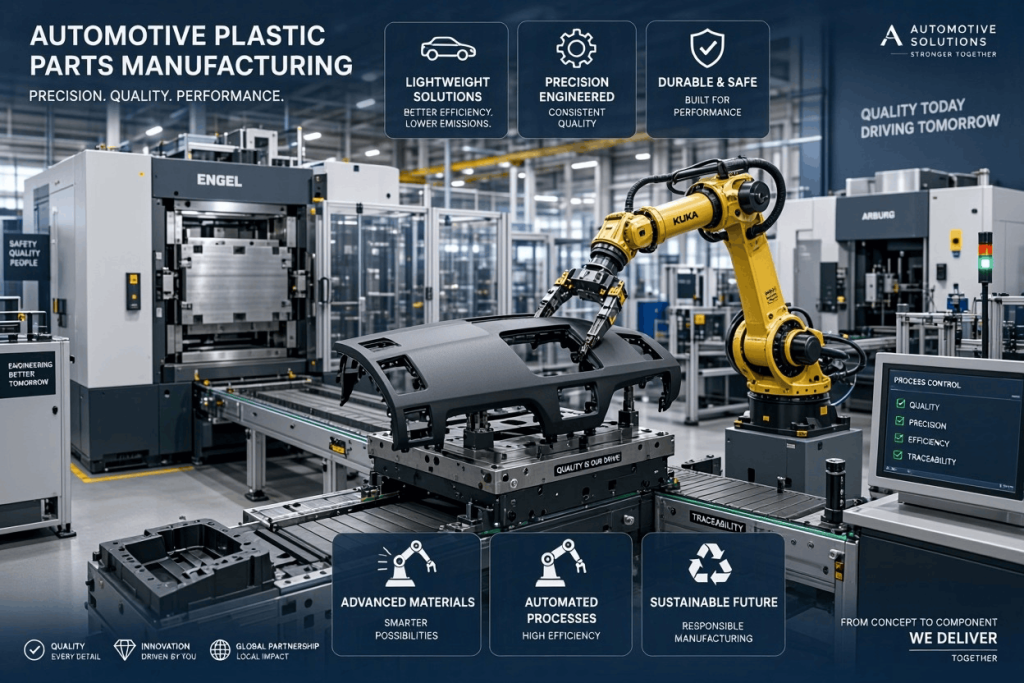
Automotive parts manufacturing involves much more than producing a component in a specific shape. Every part must perform reliably in the environment where it is installed. Components used inside the cabin, on the vehicle exterior, in electrical assemblies or under the hood may be exposed to impact, vibration, temperature changes, moisture and chemicals. Material selection, part design, mold engineering and process control therefore all contribute to the performance of the finished product.
Plastics and engineering polymers are widely used in modern vehicles because they offer a useful combination of low weight, design flexibility, corrosion resistance and production efficiency. Injection molding, in particular, makes it possible to manufacture complex components repeatedly and at scale. This guide explains the main stages of plastic automotive parts manufacturing and the factors to consider when choosing a manufacturing partner.
Why Are Plastics Used in the Automotive parts manufacturing?
The use of plastics in vehicles is driven by engineering, economic and design requirements. Depending on the application, a suitable polymer can reduce component weight while meeting the required mechanical and environmental performance. Lower vehicle weight may also contribute to improved energy efficiency, although the actual benefit depends on the vehicle design and the component being replaced.
Other advantages include the ability to create complex geometries, integrate several features into one component, achieve different colors and surface finishes, resist corrosion and support repeatable high-volume production. Plastics are not universal substitutes for metals, however. The selected material must meet the part’s load, temperature, safety and environmental requirements.
Types of Plastic Automotive Parts
Plastic components are used throughout a vehicle. Their material and manufacturing method depend on their location and intended function. Common examples include:
- Interior components: instrument-panel parts, door panels, center-console components, covers, handles, storage compartments and decorative trims.
- Exterior components: mirror housings, grilles, bumper-related parts, protective covers and exterior trim.
- Under-the-hood components: covers, clips, brackets and selected parts that must withstand operating temperatures and exposure to automotive fluids.
- Electrical and electronic components: connector housings, cable guides, equipment enclosures and insulating parts.
- Functional and mechanical components: gears, bushings, clips and connectors that require wear resistance or dimensional stability.
This is a general classification. The exact material and process should be selected from the component drawing, reference sample and customer specification. A decorative cabin trim, for example, does not necessarily require the same properties as a component operating near the engine.
Click to learn more about the various types of plastic automotive parts.
Selecting the Right Raw Material for Automotive parts manufacturing
Material selection is one of the most important decisions in plastic car parts manufacturing. Before choosing a polymer grade, the engineering and production teams should define the component’s operating conditions. They need to consider mechanical loads, impact requirements, operating temperature, exposure to oils or other fluids, moisture, surface appearance and dimensional requirements.
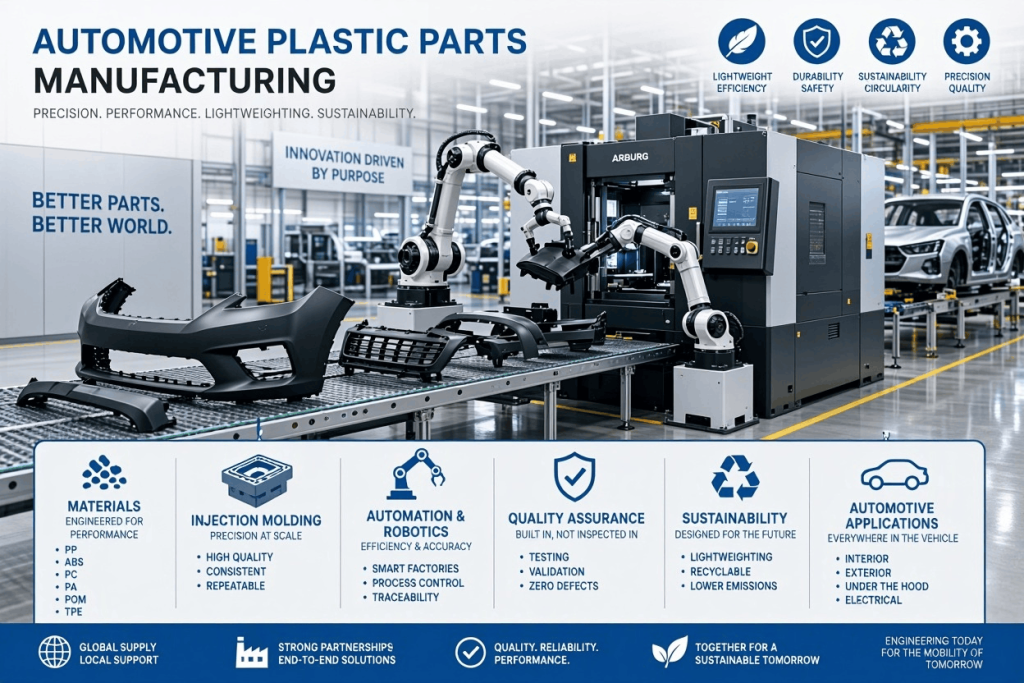
Common polymer families used in Automotive parts manufacturing include:
- Polypropylene (PP): A lightweight and processable material with useful chemical resistance. It is used in selected panels, trims, covers and exterior components.
- ABS: Often selected for components requiring a good surface finish, stiffness and impact performance, including certain interior housings and trim parts.
- Polyamide (PA or nylon): Available in grades for technical components that require strength, wear resistance or higher temperature capability. Some grades require controlled drying before molding.
- Polycarbonate (PC) and PC blends: Used where impact resistance and specific optical or appearance properties are important.
- POM and PBT: Engineering polymers used in selected precision components, connectors and applications requiring defined mechanical behavior or dimensional stability.
A polymer family name alone is not enough to approve a material. The exact grade, additives, reinforcements, colorants, processing conditions and customer approvals must also be considered. For critical automotive parts, changing the material or supplier without technical evaluation can affect product performance.
Part Design and Mold Manufacturing
Once the functional requirements and material have been defined, the part and injection mold can be engineered. Good part design considers wall thickness, ribs and bosses, draft angles, gate location, melt-flow paths and cooling strategy—not just the external shape. Uneven wall sections or poor design may lead to warpage, sink marks, short shots or internal stress.
An injection mold typically includes a cavity and core, runner system, ejection mechanism and cooling channels. Machining accuracy, assembly, surface finish and cooling-channel design all influence part quality and cycle time. A design-for-manufacturing (DFM) review before tooling begins can identify potential production issues and reduce costly mold modifications later.
Injection Molding and Production Stages
In plastic injection molding, polymer material is prepared and fed into the molding machine. It is heated inside the barrel until molten, then injected under controlled pressure into a closed mold. After the cavity is filled, holding pressure and cooling allow the part to stabilize. The mold then opens and the component is ejected.
- Material preparation: Verify the resin grade, dry the material when required, blend approved colorants or additives and prevent contamination.
- Melting and injection: Set barrel temperatures, injection speed and pressure, screw speed and other parameters according to the material and part geometry.
- Packing and cooling: Control holding pressure and cooling time to manage shrinkage and help the part retain its intended dimensions.
- Mold opening and ejection: Release the part without damaging edges, surfaces or delicate features.
- Secondary operations: Where required, remove flash and runners, finish surfaces, install inserts or complete assembly.
Automotive injection molding is most reliable when mold design, resin selection and machine settings are developed as one coordinated system. Recording process parameters and monitoring variation help maintain repeatability across production runs.
What is plastic injection molding, and how is it performed?
Quality Control and Final Inspection
Quality control should not be limited to a visual check of a few parts at the end of the production line. It begins with incoming material verification and continues throughout molding and before delivery. Material checks, machine and mold condition monitoring, process-parameter control and periodic sampling are all important.
Depending on the component and the customer agreement, inspection may cover critical dimensions, part weight, surface appearance, color, warpage, strength, fit and performance under operating conditions. Measurement equipment should be suitable for the specified tolerances and properly calibrated. For critical components, documenting inspection results and maintaining material-lot and production traceability are particularly valuable.
Factors That Affect Automotive Part Quality
- Consistency and quality of raw materials and suppliers;
- Engineering quality of the part, mold and cooling system;
- Correct control of temperature, pressure, injection speed and cycle time;
- Maintenance of the molding machine, mold and auxiliary equipment;
- Operator competence and technical supervision during production;
- Clearly defined acceptance criteria, sampling methods and production records.
Defects such as flash, bubbles, burn marks, flow lines, sink marks and warpage rarely have only one possible cause. Effective troubleshooting requires the material, mold design and processing conditions to be assessed together. Changing one setting without understanding the cause may simply create a different defect.
Why Are Standard-Compliant Automotive Parts Important?
A conforming component is one that meets the requirements defined for its intended application, including dimensions, mechanical properties, durability, safety and compatibility with the assembly. Unapproved parts or material substitutions can cause assembly problems, shorten service life or introduce performance risks.
In automotive supply chains, customer-specific specifications and agreed test methods should form the basis of inspection. Standards such as ISO 20457 provide a framework for dimensional tolerances and acceptance conditions for molded plastic parts. They do not replace vehicle-manufacturer requirements or component-specific performance testing. Acceptance criteria should therefore be agreed between the customer and the manufacturer before production.
What Makes a Good Automotive Plastic Parts Manufacturer?
Choosing the best automotive parts manufacturer should involve more than comparing quoted prices or machine capacity. A capable supplier should understand the technical requirements, recommend an appropriate material and process, maintain consistent quality at the required volume, and communicate clearly about schedules and production changes. Relevant project experience, mold-making or mold-modification capability, measurement equipment, documentation and technical responsiveness are useful evaluation criteria.
Nil Polymer manufactures polymer and plastic components and provides services including plastic injection molding, mold and component machining using CNC, and assembly. The company draws on its management team’s experience and technical workforce, with an emphasis on quality, precision and continuous process improvement. Its capabilities are intended to support different manufacturing sectors, particularly the automotive industry.
To assess a potential project, customers can share the technical drawing, an available reference sample, required material properties, expected volume and acceptance criteria. This information helps the technical team review feasibility and identify the appropriate production route.
Explore Nil Polymer’s Plastic Injection Molding, Plastic Parts Manufacturing, CNC Services and Assembly Services pages, or contact the team through the website to discuss a project.
Frequently Asked Questions About Automotive parts manufacturing
Many plastic automotive components are made by injection molding. Molten polymer is injected into a mold, cooled and ejected. The best process depends on the material, geometry, dimensions and production volume.
Polypropylene, ABS, polyamide, polycarbonate, POM and PBT are among the commonly used materials. The final choice depends on the component’s operating conditions and technical requirements.
Parts must meet approved dimensional, visual, mechanical and functional requirements to ensure reliable assembly and performance in their intended environment.
A 2D or 3D drawing, reference sample if available, required material or properties, annual or batch volume, color, operating conditions and inspection criteria help the manufacturer assess feasibility.
No. Injection molding is suitable for many complex parts and medium-to-high production volumes, but extrusion, blow molding, thermoforming and machining may be more appropriate for other geometries and applications.
Conclusion
Automotive parts manufacturing is a multi-stage process that starts with understanding the component’s requirements and selecting the right material. It continues through part and mold design, injection molding, secondary operations and quality inspection. Coordinating design, material and processing conditions is essential for producing accurate and repeatable components. Working with a manufacturer that has suitable technical capabilities, equipment and a defined quality approach can reduce project risks and support long-term supply relationships.