


What Is Plastic Injection Molding and How Does It Work?
From phone cases and tool handles to parts inside a car cabin, many of the plastic objects around us are made using a method called plastic injection molding. The reason for its popularity is clear: with a single defined mold, you can produce large numbers of parts with nearly identical shapes and dimensions.
In this article from Nil Polymer, we explain in plain language how the injection molding process works, what parts an injection molding machine has, what advantages and limitations the method has, and where it is used in the automotive industry.
How Does Plastic Injection Molding Work?
In this method, plastic material, usually in the form of small pellets or granules, is heated until it melts. The machine then forces the molten material under pressure into a closed mold. The material cools and hardens inside the mold, taking on the shape of the mold cavity. Finally, the mold opens and the part is ejected.
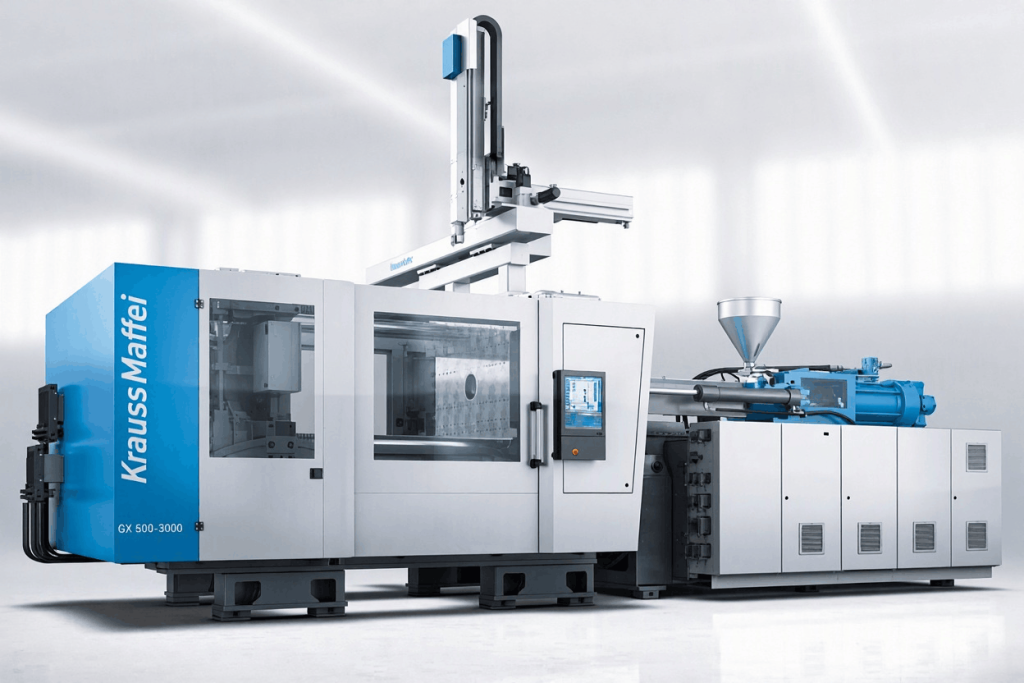
An injection molding machine is usually made up of several main sections:
- Injection unit: This includes the hopper, the heated barrel, and the screw. The screw pushes the material forward, helps make the melt uniform, and sends it toward the nozzle.
- Clamping unit: This holds the two halves of the mold firmly together during injection so that the pressure of the material does not force the mold open.
- Mold: This determines the shape and details of the final part and is usually made of steel or aluminum.
The control system, the hydraulic or electric drive system, and the cooling circuit also play a role in controlling pressure, temperature, cycle time, and part quality. For this reason, product quality does not depend on the machine alone; mold design, material selection, and proper setting of the parameters are also very important.
Steps of the Plastic Injection Molding Process
The injection cycle can take a few seconds for a small part and a few minutes for larger parts. Even so, the overall logic is similar in most production lines, and it can be summarized in three main stages.
Preparing the Raw Materials
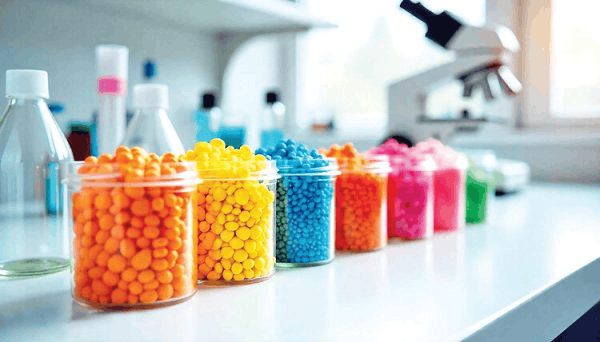
First, a material that suits the part’s application must be selected. Polypropylene (PP), polyethylene (PE), ABS, polyamide or nylon (PA), polycarbonate (PC), and POM are among the most widely used materials in injection molding. For example, polypropylene is used in many lightweight, chemical-resistant parts, while ABS is a common choice for parts that need a good appearance and impact resistance.
Some polymers, including nylon and polycarbonate, absorb moisture from the environment. These materials must be dried before entering the machine, following the instructions for the specific grade in use; otherwise, bubbles, surface streaks, or a loss of mechanical properties may occur. If the part needs a specific color, a color masterbatch is also added to the material at this stage.
Melting and Injecting the Material into the Mold
The granules enter the barrel from the hopper. As the screw rotates, it carries the material forward, and the combination of heat from the heater bands and heat generated by shear turns it into a uniform melt. The right temperature depends on the type of polymer, so a single fixed temperature cannot be assumed for all materials.
Once enough melt has been prepared, the screw moves forward and sends the material through the nozzle and the gates into the mold at a controlled pressure and speed. After the mold is filled, pressure is maintained for a set period to compensate for part of the material’s shrinkage as it cools. Setting this stage correctly helps reduce sink marks and short shots in the part.
Cooling and Ejecting the Part
After the mold is filled, the material gradually cools and solidifies. Cooling channels inside the mold carry the heat away and help keep the cycle time consistent. The cooling time depends on the type of material, the thickness of the part, the mold temperature, and the design of the cooling circuit; thicker sections usually need more time.
When the part has gained enough strength, the mold opens and ejector pins push it out. The mold then closes again and the next cycle begins. In automated lines, a robot can pick up the part and move it to the next stage. Any attached waste, such as runners or flash, is removed, and depending on the type of material and quality requirements, it may be prepared for reuse.
Advantages and Limitations of Plastic Injection Molding
Plastic injection molding has important advantages for mass production, but it is not the best choice for every project. The right decision depends on the number of parts, the complexity of the design, the type of material, and the initial budget.
Advantages
- High production speed: Once the mold is ready and the machine is set up, a large number of parts can be produced in a relatively short time.
- Accuracy and repeatability: With proper process control, the parts produced are close to one another in dimensions and appearance.
- Lower cost per part at high volumes: The cost of designing and building the mold is spread across a large number of products.
- Ability to make complex shapes: Details such as ribs, clips, and some threads can be built into the mold design.
- Variety of materials and colors: The method can be used with a wide range of standard and engineering thermoplastics.
- Waste management: Some clean process waste, such as runners, can be ground up and reused if it is compatible with the product specifications.
Limitations
- High upfront mold cost: Designing and building a mold can require a significant investment, so the method is not always economical for very low volumes.
- Lead time: Designing, building, testing, and refining a mold can take several weeks or more.
- Design requirements: Wall thickness, draft angle, gate location, and cooling must be carefully reviewed from the start.
- Cost of changes: Major modifications after the mold has been built can be time-consuming and expensive.
As a result, if the required quantity is high and the part design is relatively stable, plastic injection molding is usually a competitive option. For prototyping or limited production runs, it is better to compare the cost of the mold with methods such as 3D printing or other alternative processes.
Applications of Plastic Injection Molding in the Automotive Industry
The automotive industry needs parts that can be produced in high volumes, have a suitable weight, and are dimensionally reliable and consistent in quality. Plastic injection molding can meet these needs and, in many applications, helps reduce vehicle weight; however, the choice of material must match the temperature, mechanical load, and chemical exposure conditions.
Examples of automotive parts that may be produced with this method include:
- Dashboards and interior cabin panels
- Bumpers and some exterior body parts
- Door panels, handles, and decorative trim
- Lamp housings and frames
- Under-hood parts, tanks, and caps
- Clips, fasteners, and wiring connectors
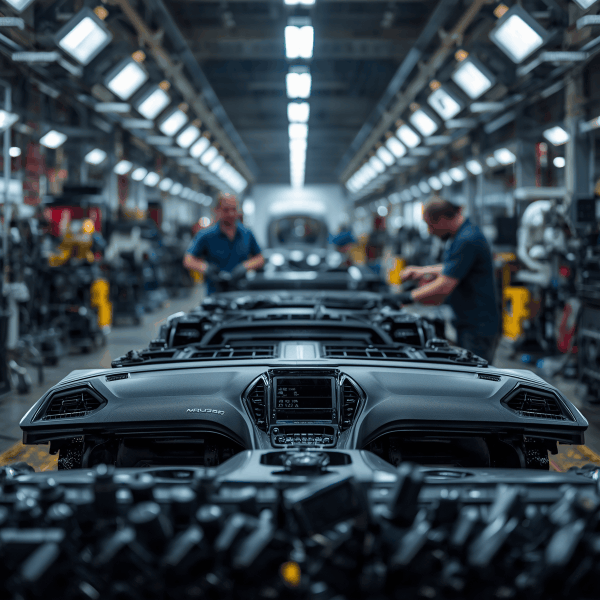
In areas exposed to heat or chemicals, engineering polymers, including reinforced polyamide, may be used. For many interior parts, materials such as ABS or polypropylene with a suitable grade and additives are also used. The final choice should be based on the technical specifications and requirements of the part, not simply on the name of the polymer.
Automotive parts manufacturing
What Factors Affect Part Quality?
Even two production lines with similar machines can deliver parts of different quality. Final quality is the result of several factors working together:
- Type and quality of raw materials: An unsuitable grade, contamination, or uncontrolled use of recycled material can change appearance and strength.
- Mold design: Gate location, material flow path, air venting, and uniform cooling affect mold filling and surface quality.
- Material and mold temperature: Too low a temperature may cause incomplete filling; excessive temperature can also degrade the material.
- Injection pressure and speed: Improper settings can cause defects such as flash, short shots, or flow lines.
- Cooling time: Insufficient cooling increases the likelihood of warping and dimensional change.
- Wall thickness: Thicker sections cool more slowly, and sink marks may form on their surface.
- Machine and mold maintenance: Wear on the screw, nozzle, or mold surfaces can gradually reduce quality and repeatability.
Defects such as weld lines, burn marks, bubbles, flash, and surface streaks usually have identifiable causes. Recording production parameters, inspecting the mold regularly, and carrying out quality control help identify the cause and prevent these problems from recurring.
Frequently Asked Questions About Plastic Injection Molding
This method usually becomes more economical at medium to high volumes, because the cost of building the mold is divided among a large number of parts. For very low volumes or prototyping, methods such as 3D printing may be more cost-effective. The break-even point depends on the complexity of the part and the cost of the mold.
Cycle time depends on the size and thickness of the part, the type of polymer, the mold design, and the machine settings, and it can range from a few seconds to a few minutes. Small, thin parts usually cool faster.
Many thermoplastics can be injection molded, including PP, PE, ABS, PS, PC, PA, and POM. The material should be chosen based on operating temperature, strength, chemical resistance, appearance, and cost.
The size and complexity of the part, the number of mold cavities, the material and build quality, the type of runner system, the cooling circuit, and the required precision are among the factors that affect the price.
Many thermoplastics can be remelted and recycled; however, the use of recycled material must be controlled according to the part’s performance and quality requirements. Not all materials and applications have the same conditions.
In injection molding, molten material is shaped inside a closed mold to produce an individual part. In extrusion, material passes continuously through a die, producing products such as pipes, sheets, and profiles.
Conclusion
Plastic injection molding is one of the most important methods for manufacturing plastic parts. With the right choice of materials, sound mold design, and careful machine setup, it makes fast, repeatable production possible. However, the upfront cost of the mold and the need for careful design mean that this process is not the right choice for every production volume or every part.
If you need help selecting raw materials or reviewing polymer grades for your project, you can get in touch with the Nil Polymer team for more information.